

Last Updated: November 8, 2026
Quick Summary
Seed Armory and Survival Garden Seeds differ mainly in format: Seed Armory sells compact, budget-friendly survival garden seeds in sealed vault kits, while Survival Garden Seeds offers individual packets and broader garden collections. Neither is a bad kit, so compare variety count, packaging, price per variety, and regional fit before buying.
- The best survival seed vault is the one you will actually plant, not the biggest seed count.
- Our All-In-One kits ship 50,000 seeds in PVC tubing rated for 15+ years of storage.
- The Backyard Seed Kit costs $99.00 and the Seed Guide can be added for $10.
- The Prepper Special gives you five All-In-One kits for the price of four at $996.00.
- Check your hardiness zone and frost-free days before buying a kit heavy in long-season crops.
Table of Contents
- Seed Armory vs Survival Garden Seeds: How the Two Vaults Compare
- What to Look For in the Best Survival Seed Vault
- How Long Do Survival Seeds Stay Viable in Storage?
- Inside an Heirloom Seed Vault Kit: What You Actually Get
- Is Survival Garden Seeds Legit? Checking the Claims
- Price Per Variety and Value for Money
- Choosing the Right Seed Vault for Your Garden
- Frequently Asked Questions
Seed Armory vs Survival Garden Seeds: How the Two Vaults Compare
Choosing survival garden seeds comes down to one question: which vault actually feeds your family when the garden matters most? Seed Armory and Survival Garden Seeds solve that question in different ways. One leans toward compact, budget-friendly assortments; the other toward larger variety counts. Neither is a bad kit. The differences show up in what you get per variety, how the seeds are packed, and whether the kit teaches you to grow and save your own stock.
Below, we compare the two vaults on contents, packaging, price per variety, and real usability, then show where our own heirloom seed vault kits fit into the picture.
Side-by-Side Comparison Table
Feature |
Seed Armory |
Survival Garden Seeds |
ARK Seed Kits |
|---|---|---|---|
Format |
Seed vault kits for emergency storage |
Individual packets and garden seed collections |
All-In-One, Backyard, and Prepper kit bundles |
Variety focus |
Compact survival assortments |
Broad vegetable and herb selection |
16 herb varieties plus 7 tomato varieties in the full kit |
Packaging |
Sealed vault format |
Standard seed packets |
Individually labeled, sealed PVC tubing rated for 15+ years |
Growing guide |
Varies by kit |
Basic planting guidance |
Seed Guide included with All-In-One kits |
Price per variety |
Higher on small kits |
Varies by packet |
Lower as kit size grows |
Best for |
Minimal-space preppers |
Gardeners buying by the packet |
Families planning long-term food security |
The table tells you the shape of each option. The details below tell you whether it fits your garden.
What to Look For in the Best Survival Seed Vault
The best survival seed vault is the one you will actually plant, not the one with the biggest number on the box. Three things decide that: variety count that matches your growing space, packaging that holds moisture out for years, and a guide that teaches seed saving so you are not rebuying every season.
Here is the checklist we would use before spending money on any vault:
- At least 15 to 20 distinct vegetable varieties, not just lettuce and radish
- Herb seeds included, since culinary and medicinal herbs are the hardest to replace
- Individually labeled packets or tubes, so you are not guessing at planting time
- Airtight, moisture-resistant packaging with a stated storage life
- A growing guide covering planting depth, spacing, and harvest timing
- Seed-saving instructions for at least the open-pollinated crops
- Non-GMO, open-pollinated varieties you can replant from your own harvest
- A price per variety you can justify against buying packets separately
Watch out: the most common mistake is buying a vault with a huge seed count and a thin variety list. Fifty thousand seeds of eight crops will not feed a family through a bad year.
How Long Do Survival Seeds Stay Viable in Storage?
Seed viability depends on storage conditions, and germination rates decline over time. The variables that matter are moisture, temperature, and oxygen. Keep seeds dry, cool, and sealed, and germination holds up far better than seeds left in a hot garage.
Viability is crop-specific. Beans and corn fade faster than tomatoes, and brassicas sit somewhere in the middle. For a deeper walkthrough of conditions and container choices, our guide on how to store heirloom seeds long term covers the practical setup.
Our All-In-One kits are packaged in indestructible PVC tubing, labeled and sealed separately, and the product listing rates them for storage of 15+ years.
Inside an Heirloom Seed Vault Kit: What You Actually Get
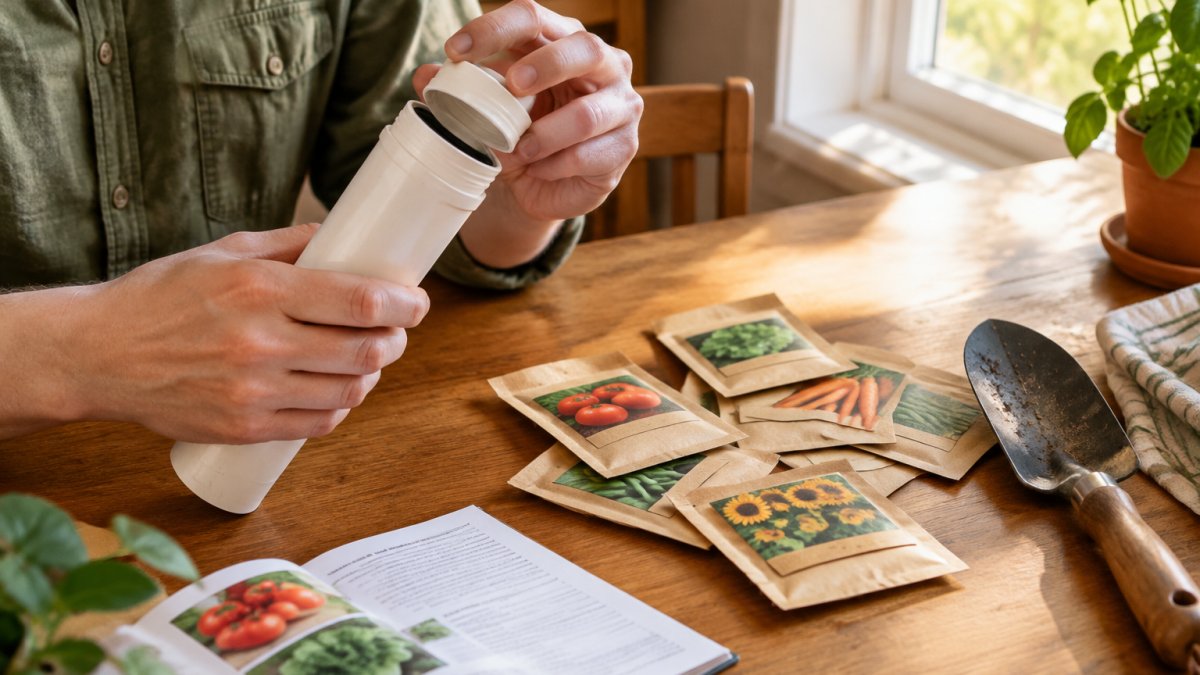
Our All-In-One Seed Kit is a good example of what a full vault looks like in practice. It ships 50,000 total seeds across vegetables and herbs, including 7 tomato varieties, 4 lettuce varieties, 4 to 5 dry bean varieties, and 16 culinary and medicinal herb varieties. Every variety is labeled and sealed on its own, and the Seed Guide comes with it.

Smaller kits make sense for smaller plots. The Backyard Seed Kit carries over 20,000 seeds for a first-season garden, and the guide can be added for $10.
Is Survival Garden Seeds Legit? Checking the Claims
This section gives a framework for checking any survival seed brand against four points: germination evidence, non-GMO and organic scope, storage life with conditions attached, and regional fit. Legitimacy is not the same as fit, and a seller can still offer a kit that is wrong for your climate.
1. Germination claims. A germination rate is a measured number, not a slogan. Reputable seed sellers publish a minimum germination percentage per crop, and many state that they test lots before packing. When you evaluate Survival Garden Seeds or any brand, look for a stated germination standard and a testing policy on the product page or in the brand's help content. If a listing only says "high germination" with no number, treat that as a marketing claim. The practical test you can run at home is simple: count out 10 seeds from one packet, place them on a damp paper towel inside a sealed bag, keep them at room temperature, and count sprouts at the interval the packet recommends for that crop. Ten seeds is a small sample, so repeat with a second packet before drawing conclusions, a single bad packet is not proof of a bad brand, and a single good one is not proof of a good brand.
2. Non-GMO and organic language. Confirm whether the non-GMO claim covers every variety in a kit or only the headline crops. The same applies to organic: a collection can be mostly conventional seed with one or two organic packets. Read the variety list, not the banner. For survival planning, the more important attribute is open-pollinated status, because that is what lets you save seed and replant without buying again.
3. Storage life with conditions attached. A shelf-life figure without storage conditions is marketing. Seed longevity depends on moisture, temperature, and oxygen, and the same packet stored in a cool, dry closet will outlast one stored in a hot garage by years. Most practitioners find that ordinary room conditions give three to five years of reliable viability for many vegetables, while properly dried and sealed seed stored cold and dark can hold much longer. Ask two questions of any brand: what conditions does the stated shelf life assume, and is each variety sealed separately? A vault that seals varieties individually protects you from one damp packet ruining the whole kit.
4. Regional fit and growing-season suitability. This is the gap most comparisons skip entirely. A kit heavy in long-season crops like watermelon, cantaloupe, and late peppers will disappoint a gardener with a short growing season, no matter how good the germination rate. Check your hardiness zone and your frost-free day count before you buy, then compare the kit's variety list against that window. Corn and beans perform across a wide range; tomatoes and peppers need a real summer; fast crops like radish, spinach, and lettuce buy you a harvest while the long-season crops catch up. A brand can be entirely legitimate and still sell a kit that is a poor match for your region, that is a fit problem, not a fraud problem.
Customer reviews help, but read them for specifics rather than star averages. Comments about germination rates, packet labeling, and ease of planting are worth more than a five-star rating with no detail. Customer Emily R and Jason T have commented on product quality and packaging.
Watch out: the most common evaluation mistake is treating a brand's legitimacy as proof of kit quality. A seller can offer a kit with a thin variety list, vague storage claims, and varieties that do not suit your zone. Verify the four points above against the specific kit you are considering, not against the brand as a whole.
Price Per Variety and Value for Money
Value in a seed vault can be judged by price divided by usable varieties, not price divided by seed count.
Run the math on our kits and the pattern is clear:
Kit |
Price |
Varieties Included |
What You Are Paying For |
|---|---|---|---|
Backyard Seed Kit |
$99.00 |
20+ vegetable and herb types |
A first garden with herbs included |
All-In-One Seed Kit |
$249.00 |
50,000 seeds across dozens of varieties |
Full pantry coverage plus the Seed Guide |
Prepper Special |
$996.00 |
5 All-In-One kits |
Five kits for the price of four |
Price
If you want to know why heirloom seed carries a higher sticker than commodity packets, our article on why heirloom seeds cost more explains the economics.
Choosing the Right Seed Vault for Your Garden
Match the vault to the garden you have, not the one you plan to build someday. A container gardener on a balcony needs different varieties than a household with a quarter acre and a root cellar.
Use this decision path:
- Smaller plot: Backyard Seed Kit, $99.00, with the Seed Guide available for $10.
- Full household food planning: All-In-One Seed Kit, $249.00, with 50,000 seeds and the Seed Guide included.
- Group, family, or neighborhood reserve: Prepper Special, $996.00, five kits for the price of four.
- Comparing brands first: read our Garden Pulse comparison to benchmark two other vaults against these.
Climate matters too. Check your growing season before committing to a kit heavy in long-season crops like watermelon and cantaloupe.

The real challenge is not picking a brand. It is buying a vault you will still trust in year five, when the garden has to carry the grocery bill. ARK Seed Kits builds for that moment with 100% organic heirloom seeds, individually sealed varieties in PVC tubing rated for 15+ years, and a Seed Guide that teaches you to grow, harvest, and save your own seed. Get started with ARK Seed Kits and turn a shelf of tubes into a food supply you control.
Frequently Asked Questions
Is Survival Garden Seeds a good brand compared to Seed Armory?
The choice comes down to kit contents, storage packaging, and price. Compare the actual seed quantity, how the packets are sealed, and whether a growing guide is included before deciding. A kit with 50,000 seeds and clear planting instructions is worth more than a bigger variety list with vague storage claims.
How long do survival seeds stay viable if I store them for an emergency?
ARK All-In-One kits are packaged in indestructible PVC tubing, labeled and sealed separately, and the product listing rates them for storage of 15+ years.
Are heirloom seed vault kits worth buying instead of packets from a garden center?
A vault kit makes sense when you want one purchase that covers a full garden, comes sealed for long-term storage, and includes open-pollinated varieties you can save seed from. If your goal is food security or self-reliance, the sealed packaging and seed-saving instructions in a vault kit are the parts that justify the price.
Can I save seeds from a survival seed kit and replant them next year?
Yes, if the varieties are heirloom or open-pollinated rather than hybrid. Open-pollinated plants produce seed that grows true to type, so you can replant from your own harvest each season. Keep squash, corn, and other wind-pollinated crops separated by distance to avoid cross-pollination. Dry the seed fully and store it in a labeled airtight container away from heat and light.
What should I look for in the best survival seed vault?
Check four things: total seed count and variety list, whether seeds are non-GMO and open-pollinated, how the packets are sealed for moisture control, and whether a growing guide is included. Also confirm the varieties suit your hardiness zone and growing season.


