


How to Tell If Stored Seeds Are Still Viable
07:00 AMLast Updated: November 15, 2026
Quick Summary
Stored seeds last anywhere from a few months to several years, depending on the crop and how they were stored. Onion, parsnip and leek seeds fade fastest, while lettuce, cabbage and carrot seeds often stay usable for several years. Cool, dry, sealed storage extends life, and a simple home germination test shows whether an older packet is still worth planting.
- Onion, parsnip and leek seeds are short-lived and are best sown from fresh packets.
- Lettuce, cabbage and carrot seeds are often cited as longer-lasting vegetable seeds.
- Keep seeds cool, dry and sealed, and add silica gel to containers to limit humidity.
- Test 20 to 30 seeds from a packet, and count sprouts over 7 to 14 days.
- Divide the fresh sowing rate by the germination rate to set a thicker sowing rate.
Table of Contents
- How Long Stored Seeds Last by Crop Type
- How Seed Storage Conditions Change Longevity
- How Long Seeds Last in Packets
- How Long Seeds Last in the Freezer
- Seed Viability Test: A Home Germination Protocol
- Adjusting Sowing Rates and Deciding Whether Old Seed Is Worth Planting
- Start Your Seed Stash With a Plan That Lasts
- Frequently Asked Questions
Most gardeners ask the same question once a seed box has been sitting in the back of a closet for a few years: how long do stored seeds last?
Seed lifespan is a bit like a clock that starts ticking at harvest. Some seeds stay alive for a few years, while others fade within months. Knowing the pattern for each crop helps you decide what to plant, what to retest and what to replace.
How Long Stored Seeds Last by Crop Type
Seed viability varies widely across vegetables, herbs and flowers. A general rule many growers use is that short-lived seeds need fresh stock every year or two, while long-lived seeds can often be planted for several years if they were stored well.
Short-lived seeds: onion, parsnip, and leek
Onion, parsnip and leek seeds are among the quickest to lose vigor. These are best sown from fresh packets. If you must use older seed, plan on a higher sowing rate and a germination test first.
Medium-lived seeds: beans, tomatoes, and squash
Beans, tomatoes and squash generally keep for a few years when stored cool and dry. Tomato and squash seed often holds up better than many gardeners expect. Still, check germination before a big planting, since results can vary from lot to lot.
Long-lived seeds: lettuce, cabbage, and carrots
Lettuce, cabbage and carrot seeds are often cited as some of the longer-lasting vegetable seeds. Many people get several years of usable germination from them under good storage. Even so, age alone does not guarantee results, so a quick test is still the safest step.
How Seed Storage Conditions Change Longevity
Storage is the single biggest factor you control. Seeds are living embryos packed in a dry shell, and heat, moisture and air speed up their decline. Keeping seeds cool, dry and sealed slows aging.
Practical storage habits that help:
- Keep seeds cool (Unplanted seeds). A steady temperature below room temperature is better than a warm shelf.
- Keep seeds dry. Long-term storage containers, humidity, and temperature practices are covered in detail in the heirloom long-term storage guide. Humidity is the most common enemy. Add silica gel or another desiccant to sealed containers.
- Seal them tight. Use airtight jars, mylar pouches or sealed containers to limit moisture.
Good storage will not make old seed fresh, but it can add years of useful life to a collection.
How Long Seeds Last in Packets
Seed packets are convenient, but they are not always the best long-term container. Paper packets let moisture in, and they are easily damaged in a garage or shed. If you buy packets for the season, move unused seed into sealed containers after planting.
Check the packed-for or packed-date printed on the packet. Many seed companies print a date, and the age of the seed matters more than the package.
How Long Seeds Last in the Freezer
Freezing is a popular way to extend seed life, and many people use it for their longest-term stock. Seeds should be dry before freezing, sealed in airtight containers, and allowed to warm to room temperature before opening to prevent condensation (seeds project).
Freezer storage is not a guarantee. Power outages and repeated door openings can cause temperature swings. For a reliable freezer setup, use a dedicated chest freezer and keep a sealed, labeled container for each crop.
Seed Viability Test: A Home Germination Protocol
A germination test turns a guess into a number you can plan around. The goal is a repeatable protocol: same sample size, same moisture, same temperature, same check date, so results from one packet are comparable to the next. Most practitioners find that a paper-towel test run at home is accurate enough to decide whether to sow a packet, sow it thicker, or replace it.
What you need
- A clean paper towel or coffee filter that holds moisture without falling apart
- A resealable plastic bag or a small sealed container
- A permanent marker and a label
Step-by-step protocol
- Draw a sample. Count out 10 seeds for a quick check. For a packet you plan to rely on for a full planting, test 20 to 30 seeds so the percentage is more stable. Do not pick only the plumpest seeds, take a random sample from the packet so the result reflects the whole lot.
- Label first. Write the crop, variety, packet date, number of seeds, and test start date on the bag before the towel goes in. A test with no label is a test you will misread two weeks later.
- Moisten the towel. Run the paper towel under water and wring it out until it is damp but not dripping. The target is a wrung-out sponge: moist to the touch, with no standing water. Seeds that sit in water can rot instead of sprout.
- Arrange the seeds. Space the seeds on one half of the towel so they are not touching, then fold the other half over them. Spacing matters because a rotten seed can spread mold to its neighbors.
- Bag and place. Slide the folded towel into the bag and seal it loosely, leaving a small air gap. Put the bag in a warm spot. A common target is roughly 70 to 75°F for warm-season crops such as tomatoes, peppers, and squash; cool-season crops such as lettuce and spinach germinate more reliably closer to 60 to 65°F.
- Check on a schedule. Open the bag every two days and count seeds that have a visible root, often called the radicle. A seed counts once a root has broken through the seed coat, even if no leaf has appeared. Mist the towel if it has dried out, and reseal the bag.
- Know when to stop. Most vegetable and herb seeds show their answer within 7 to 14 days. Slow crops such as parsley and parsnip can take up to 21 days. Record the final count on the day the last viable seed should have sprouted for that crop, not the day you get bored.
- Do the math. Germination percentage = (sprouted seeds ÷ total seeds tested) × 100. If 7 of 10 seeds sprout, the rate is 70%. If 18 of 30 sprout, the rate is 60%.
Watch out: a towel that dries out mid-test will produce a falsely low result, and a towel that stays soaking wet will grow mold and rot the sample, check moisture every time you open the bag.
Reading the result
Treat the percentage as a planning number, not a verdict. A result in the high range means the packet is behaving close to fresh. A mid-range result means the seed is usable with a thicker sowing rate.
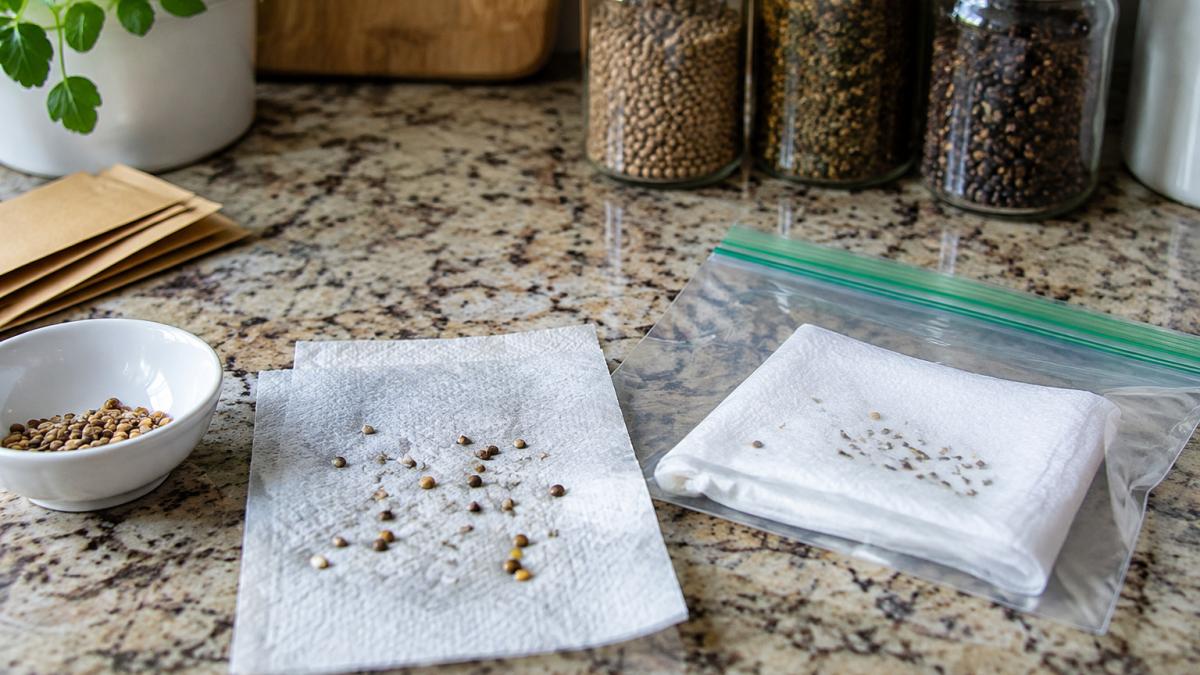
A simple home germination test shows how many seeds in a packet still sprout, and the results can guide how thickly you sow. Beginner guidance on saving and handling heirloom seeds covers the same topic for newer growers.
| Step | What to do | Time or frequency |
|---|---|---|
| Draw a sample | Count 10 seeds for a quick check, or 20-30 for a planting you rely on | Before starting |
| Moisten towel | Wring out a paper towel until damp, not dripping | At setup |
| Arrange and bag | Space seeds apart, fold towel, seal bag loosely | At setup |
| Keep warm | Warm-season crops near 70-75°F; cool-season 60-65°F | Ongoing |
| Check moisture | Open bag, count sprouted seeds, mist if dry | Every 2 days |
| Stop and count | Most vegetables show results in 7-14 days; parsley and parsnip up to 21 | 7-21 days |
| Calculate rate | Sprouted seeds ÷ seeds tested × 100 | At the end |
Adjusting Sowing Rates and Deciding Whether Old Seed Is Worth Planting
A germination test is only useful if it changes what you do in the garden. The practical move is to convert the percentage into a sowing rate, then decide whether the packet earns space or gets replaced. This is also the workflow to use when you inherit a box of seed with no history and need to triage it fast.
Convert the test result into a sowing rate
Start with the sowing rate you would use for fresh seed, then divide by the germination rate expressed as a decimal. If fresh seed calls for 1 seed per hole and your test came back at 50%, you sow 2 seeds per hole (1 ÷ 0.50 = 2).
A few practical adjustments:
- Direct-sown crops such as beans, squash, corn, and cucumbers tolerate a thicker sowing rate well because thinning is easy and the extra seedlings are cheap insurance.
- Root crops such as carrots and beets are less forgiving of crowding, so a thicker rate needs earlier and more careful thinning to avoid twisted roots.
- Transplanted crops such as tomatoes and peppers can be sown thicker in flats and the strongest seedlings potted up, which wastes little.
Watch out: a low germination rate often means uneven emergence, not just fewer plants, the seedlings that do come up may be slower and weaker, so do not assume a thick sowing rate fully compensates.
A triage workflow for old or inherited collections
When you face a box of unknown packets, do not test everything. Work in this order:
- Sort by crop lifespan first. Pull out the short-lived crops, onion, leek, parsnip, and similar, and treat anything over two seasons old as a replacement candidate unless a test says otherwise.
- Check the packet dates. Separate packets with a readable packed-for date from unlabeled ones. Dated packets tell you how old the seed is; unlabeled packets go to the test pile regardless of appearance.
- Test the high-value and high-cost crops first. A packet that will fill a whole bed, or a variety you cannot easily rebuy, deserves a 20-to-30-seed test before you commit garden space. A spare packet of an easy crop can simply be sown thicker.
- Group the rest by decision. Sow now at normal rate, sow now at a thicker rate, test before deciding, or discard. Discard only when a test comes back near zero or the seed is visibly moldy, shriveled, or infested.
- Record the outcome. Write the test date and percentage on the packet so next season's decision starts from data instead of memory.
When to replace rather than stretch
Replace the packet when the crop is short-lived, when the test result is low, or when the planting is one you cannot afford to lose, a main-season crop, a market garden bed, or a variety you depend on.
Start Your Seed Stash With a Plan That Lasts
If you want a stash that stays useful for years, plan ahead. For a smaller starting point, the Backyard Seed Kit offers a wide variety of crops at $109.00, and the Seed Growing Guide can be added to it for $10. Compare nine long-term food storage seed kits side by side before you choose.
Ready to build a seed supply that is built to last? Shop the All-In-One Seed Kit today and start your own stash with a plan.
Frequently Asked Questions
Are 20-year-old seeds still good?
Some are, but germination drops sharply with age. Onion, parsnip, and leek seeds rarely sprout reliably after a few years, while many bean, squash, and lettuce seeds can still germinate after 5 years or more if they were kept cool and dry. At 20 years, germination is usually low and uneven, so run a germination test on a sample of 10 seeds before committing a garden row. If the test shows low germination, sow more thickly or buy fresh seed for the crops that matter most.
Can I use 10-year-old seeds?
Possibly, depending on the crop. Carrots, cabbage, and lettuce often remain usable for several years under good storage, but germination at 10 years is typically much lower than fresh seed. Test a sample first. If germination is around 50 percent, you can still sow by increasing the seeds per spot and thinning the seedlings later. Keep a record of the packet date and your test results so you can compare batches over time.
How long do seeds last in packets?
Most commercial seed packets are sealed for short-term retail sales and stay viable for roughly 1 to 3 years when stored well. Packet dates are often a sell-by or packed-for guide rather than a hard expiration. Onion and parsnip seed may decline within a year or two, while beans and squash tend to hold up longer. Store unopened packets in a cool, dry place and reseal opened packets with a desiccant to slow moisture uptake.


